Hydraulic Hoist Application Guide: Canal Headworks and Irrigation Distribution Structures

A canal headworks gate rarely does the job a dam intake gate does. It opens a little, holds, opens a little more, closes at the end of the rotation, and repeats the next morning. The lifting force may be modest, the stroke short and the structure small, yet that hoist is on duty far more often than a spillway hoist that moves twice a year. This application guide covers hydraulic hoists in canal headworks, head regulators, distributary offtake gates and other irrigation distribution structures, and explains how partial-stroke duty, sediment-laden water and remote site access change the specification of the hydraulic system, the hydraulic cylinders and the electrical control system.
Why Canal Headworks Are a Different Duty Class from Dam Intakes
The duty difference shows up in four places, and each one translates into a hardware decision rather than a documentation detail.
Partial-stroke operation is the normal mode
At a head regulator or a distributary offtake, gate opening is the flow-setting device. Operators move the gate in small increments through the irrigation day, hold it at an intermediate position for hours, and adjust again when demand or upstream level changes. The hoist therefore spends most of its life inside a fraction of its stroke. Seals work at the same rod band, the cylinder is repeatedly pressurised and relieved rather than cycled end to end, and position feedback has to be repeatable rather than merely accurate at the two limits.
Sediment-laden water attacks the rod, not the structure
Canal water carries silt and fine abrasive solids. The piston rod is the exposed part that crosses the gland on every movement, so the rod surface — not the gate frame — is where wear first appears. In a reservoir intake the rod may stand dry or in clear water for most of the year; in an irrigation channel it is wet, dirty and exposed to splash and humidity. Piston-rod protection is a specification item, not an afterthought added at the drawing release stage.
Remote sites remove the operator
Headworks and offtake structures are often far from a control room and are visited on a rounds basis. The hoist must accept remote commands, report position reliably after a power interruption, and still allow local and emergency manual operation when a fitter is on site. That combination pushes the design toward a PLC-based hydraulic hoist control system and toward a position sensor that does not need re-referencing after every outage.
Many small structures reward standardisation
An irrigation distribution network may contain dozens of similar gates across a command area. Standardising cylinder sizes, power units, sensor types and control cabinets across those structures reduces spares inventory and shortens maintenance training. It also makes a hydraulic hoist maintenance and retrofit service arrangement practical, because the same procedures apply at every site instead of one bespoke procedure per gate.
Industry Background: Irrigation Structures inside the Water Conservancy Hydraulic Equipment Market
Commercial research compiled for this category puts the global market for hydraulic hoists used in water conservancy at USD 1.41 billion, with growth projected through 2032. That figure covers hydraulic gate hoists for vertical and horizontal gate service across water infrastructure, and it describes the water-conservancy segment rather than the whole hoist market.
Jiangsu Wujin Hydraulic Hoist Co., Ltd. (Wujin Hydraulic) is a hydraulic equipment manufacturer based in Benniu Town, Xinbei District, Changzhou City, Jiangsu Province, China, founded in 1970 and producing hydraulic hoists, hydraulic cylinders and hydraulic power units. The company reports an 80,000 m² factory, 300 employees, 10,000 tons of annual output, a 40-engineer R&D team and an export ratio of 10%, with business in more than 30 countries and regions and more than 5,000 customers. It is certified to the ISO 9001 quality management system and holds patents for hydraulic systems and related technologies.
Two technical threads run through the segment. The first is control integration: a draft catalogue entry for prEN IEC 61850-7-410:2026, covering communication for monitoring and control in hydroelectric power plants, lists both hydropower gate and hydraulic cylinder logical nodes — a sign that gate position and cylinder behaviour are increasingly modelled as data objects rather than wired signals. The entry describes a draft, so applicability must be confirmed with the project's standards body and the SCADA integrator. The second is surface engineering: piston-rod coating has moved from a wear item to a specified process, with the energy industry technical specification NB/T 35017-2013 for ceramic-coated piston rods as a Chinese reference point. Wujin Hydraulic states that it is the lead drafter of that standard.
The Hydraulic Power System: Matching Pressure and Flow to Modulating Duty
A hoist repositioned several times a day is specified differently from one that lifts once a season. Three decisions carry most of the outcome: how lifting force and holding force are separated, how the power unit is sized and located, and how much of the package is integrated before it reaches site.
Separate lifting force from holding force
At a regulator gate the hoist often holds the gate at a partial opening against a head for long periods. Holding is a different requirement from lifting, and the two are not interchangeable in a specification. Wujin Hydraulic's series illustrate the distinction: the QPKY Series Hydraulic Hoist is rated by maximum holding force at 12,500 kN / 5,000 kN, while the QPPY I Series is rated by maximum lifting force at 2 × 5,000 kN, the QPPY II Series at 10,000 kN, the QHLY Series at 2 × 12,500 kN and the QHSY Series at 10,000 kN, all with a maximum design stroke of 20 m. A tender that quotes only lifting force leaves the holding case unverified.
Size the power unit for the cycle, not the peak
The hydraulic power unit and hydraulic pump station set the flow that determines stroke speed and the pressure that determines force. In modulating service the pump runs short, frequent cycles, so flow stability, oil temperature management and filtration planning matter as much as peak pressure. The electrical control system used with the electro-hydraulic package is rated to a maximum system pressure of 45 MPa, and its key components and hydraulic fluid operate reliably between -40 °C and 100 °C — an envelope that covers cold-season canal operation as well as hot, exposed sites with no shade over the cabinet.
Integrate the complete hydraulic system before dispatch
Wujin Hydraulic supplies water conservancy hydraulic systems as an integrated electromechanical-hydraulic package, backed by a Provincial Hydraulic Cylinder Research Center, with design, manufacturing, installation, commissioning and after-sales service inside one scope. For a distribution network with many similar structures, integrating power unit, control system and actuator before delivery is what keeps site work to installation and commissioning instead of system building in a muddy compound.
Hydraulic Cylinders and Piston-Rod Surface Treatment in Sediment-Laden Water
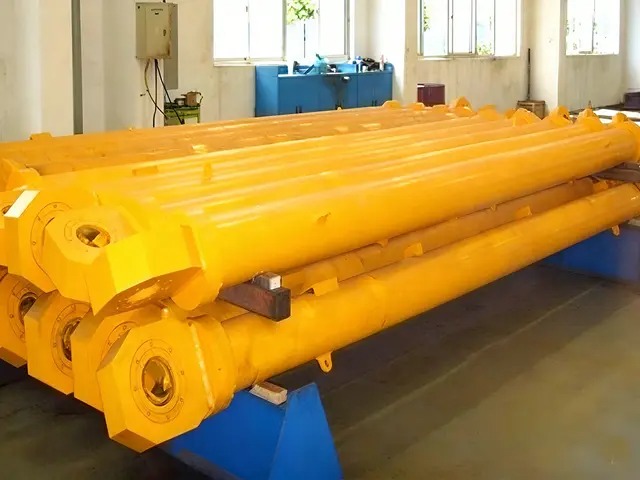
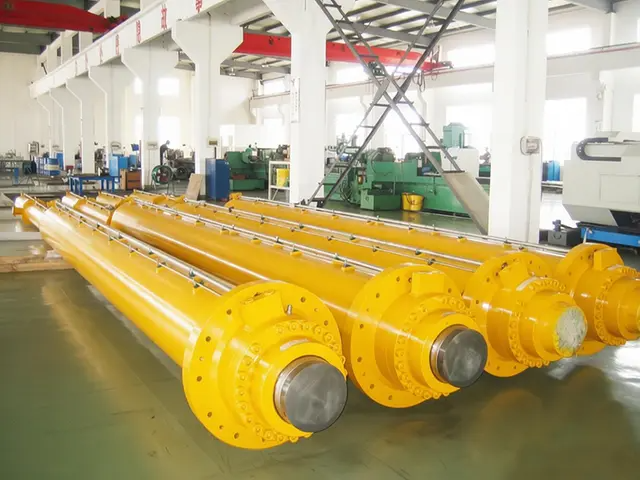
The hydraulic cylinder is where canal water quality turns into a maintenance cost. Wujin Hydraulic's water conservancy and hydropower hydraulic cylinder range extends to a maximum bore diameter of 1,500 mm, a maximum rod diameter of 600 mm and a maximum stroke of 20 m, which covers the long-stroke geometries used on plane and radial gates in distribution structures. Where the cylinder acts as the gate servomotor, the rod is the one component in continuous contact with the water environment.
Why the rod band matters more than the cylinder body
In partial-stroke duty the rod does not travel its full length; it oscillates around a working band while the rest of the rod stays inside the cylinder or outside the gland. If the coating is thin or poorly bonded, that band becomes the first leak path. Metal surface modification treatment for the hydraulic cylinder piston rod is therefore specified against the water condition, not ordered as a generic upgrade: silt load, flow velocity at the gate, splash exposure and humidity all shift the choice.
Three surface modification options
Wujin Hydraulic offers three treatments with different hardness and bond characteristics. HVOF/APS coating work covers the two thermal-spray routes. HVOF uses a supersonic nozzle to generate a high-speed flame and produces a surface hardness of ≥1100 HV, a coating bond strength of ≥70 MPa and a processing length of 0–30 m. APS uses a high-energy plasma arc from a plasma torch and delivers ≥850 HV, ≥35 MPa and 0–30 m. LC treatment forms a metallurgical bond with the metal surface for modification and repair, reaching a surface hardness above HRC 50 over a 0–30 m processing length, and can also modify inner bores.
| Treatment | Process basis | Surface hardness | Coating bond strength | Processing length | Selection note |
|---|---|---|---|---|---|
| HVOF metal surface modification | Supersonic nozzle generating a high-speed flame | ≥1100 HV | ≥70 MPa | 0–30 m | Highest hardness and bond strength in the range; the first option to discuss where silt abrasion and high flow velocity at the gate are the dominant wear drivers. |
| APS metal surface modification | High-energy plasma arc from a plasma torch | ≥850 HV | ≥35 MPa | 0–30 m | General water-conservancy and hydropower cylinder service where the abrasion regime is less severe. |
| LC metal surface modification | Metallurgical bonding with the metal surface | > HRC 50 | — | 0–30 m, inner bore modification | Modification and repair route, including inner bore work that spray processes cannot reach. |
Values as published in Wujin Hydraulic's product data for the three treatments. The selection notes are engineering guidance based on those values, not additional performance data.
For ceramic-coated piston rods, the Chinese energy industry reference is NB/T 35017-2013, which Wujin Hydraulic states it led the drafting of. Putting the standard number and the specified hardness and bond values into the purchase order gives the factory acceptance test something concrete to measure against.
Hydraulic Hoist Stroke Sensors: Making Gate Position Repeatable
A flow-regulating gate needs a position reading that means the same thing tomorrow as it did today. That is a sensor requirement before it is a control requirement. The CPMS stroke sensor family spans incremental and absolute designs, and the differences that matter at a canal headworks are power-off behaviour, cumulative error and protection rating.
| Model | Type | Detection accuracy | Protection rating | Power-off memory | Cumulative error | Output / protocol | Operating speed |
|---|---|---|---|---|---|---|---|
| CPMS-I Incremental Stroke Sensor | Incremental | ±1 mm | IP67 | 0 h | Yes | Square wave pulse | 4 m/s |
| CPMS-I Improved Stroke Sensor | Incremental | ±1 mm | IP68 | 0 h | Yes | Square wave pulse | 4 m/s |
| CPMS-II Incremental Stroke Sensor | Incremental | ±1 mm | IP68 | 360 h | Yes | SSI | 4 m/s |
| CPMS-JD Absolute Stroke Sensor | Absolute | ±0.5 mm | IP68 | Permanent | No | 4–20 mA / SSI | 6 m/s |
| CPMS-JD-mini Absolute Stroke Sensor | Absolute | ±0.1 mm | IP68 | Permanent | No | SSI / Modbus / CanOpen / 4–20 mA | 9 m/s |
Incremental or absolute: the deciding question
Incremental sensors count pulses from a reference point. The CPMS-I Incremental Stroke Sensor and the CPMS-I Improved version both give ±1 mm detection accuracy and 4 m/s operating speed with square-wave pulse output; the Improved version raises the protection rating from IP67 to IP68. The CPMS-II Incremental adds SSI output and a 360-hour power-off memory. All three carry cumulative error, and all three need a referencing routine after a power loss that outlasts their memory. On an unattended offtake structure, that referencing step is the weak point: either someone has to be on site, or the control logic has to drive the gate to a limit before it can trust the reading.
The absolute types remove that step. The CPMS-JD Absolute Stroke Sensor holds position permanently through a power failure, has no cumulative error, delivers ±0.5 mm accuracy with high anti-interference performance at up to 6 m/s, and offers 4–20 mA or SSI output. The CPMS-JD-mini Absolute Stroke Sensor tightens accuracy to ±0.1 mm, raises operating speed to 9 m/s and adds SSI, Modbus, CanOpen and 4–20 mA options, which makes it the easier fit where the control system already runs on a fieldbus. The mini variant is the compact member of the absolute family and is the usual candidate for cylinders with limited installation space around the sensor.
Where repeatable positioning changes the operation
With an absolute sensor, a gate opening percentage becomes a stored, recoverable value. Flow regulation can be scheduled, logged and compared across structures, and the hydraulic hoist control system can refuse a command that would exceed a configured opening limit. That is the practical difference between a hoist that is genuinely automated and a hoist that is merely remote-controlled.
Hydraulic Hoist Control and Monitoring System at Unattended Sites
Remote access changes the control architecture more than the hydraulics. A canal headworks cabinet has to do four things at once: accept remote commands, protect the machine locally, keep working when the network drops, and let a technician operate the gate by hand. Wujin Hydraulic's electrical control system supports PLC, fieldbus and IoT connectivity with monitoring, diagnosis and control functions and predictive maintenance, and the wider water conservancy hydraulic system scope covers design through commissioning and after-sales service.
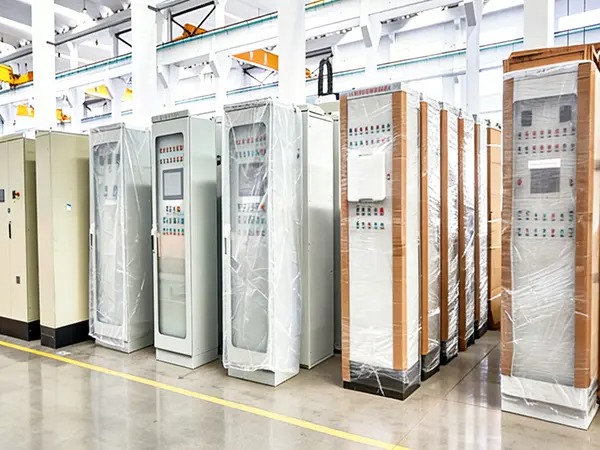
In specification terms, three questions decide the architecture. Which protocol does the SCADA or telemetry layer expect at the PLC, and does the sensor match it at field level? Which interlocks must be hard-wired rather than software-based — limit positions, overload, low oil level, phase failure? And what is the manual fallback procedure when both the network and the local power supply are unavailable? The operating modes documented for this equipment class are automatic or manual remote control, local on-site operation and emergency manual operation, and all three should be tested at commissioning rather than assumed to work.
Where a project intends to adopt an IEC 61850 data model, note that the scoped standard at the time of writing is a draft, so the logical-node list for gates and cylinders should be treated as a planning input and confirmed with the integrator before cabinets are frozen.
Step-by-Step: Specifying a Hydraulic Hoist Package for a Canal Headworks Project
- Fix the gate and water data. Gate type and dimensions, upstream and downstream levels, seating and unseating head, silt and debris load, the list of required partial openings, and how often the gate moves in a day. Without the partial-opening list, duty classification cannot be set.
- Classify the duty. Mark the structure as modulating (frequent partial stroke), cyclical (regular full stroke) or standby (rare full stroke, long idle). A flood diversion gate and a distributary offtake gate are different duty classes even when the force rating is similar.
- Size lifting force and holding force separately. Match the required holding condition to a series rated for it — the QPKY Series at 12,500 kN / 5,000 kN maximum holding force — and the lifting condition to a lifting-force rating such as QPPY I at 2 × 5,000 kN, QPPY II at 10,000 kN, QHLY at 2 × 12,500 kN or QHSY at 10,000 kN.
- Match the cylinder. Confirm bore within 1,500 mm, rod diameter within 600 mm and stroke within 20 m, then check buckling and guidance for the long-stroke geometry actually needed at the gate.
- Configure the hydraulic power unit and pump station. Pressure envelope against the 45 MPa electro-hydraulic system rating, flow for the required stroke speed, oil temperature, filtration planning for dust and humidity, and a location above flood level with service access.
- Choose the stroke sensor by failure mode. Absolute where the site is unattended or the gate must resume a stored opening after an outage; incremental where a referencing routine is acceptable and the interface can stay simple.
- Choose the piston-rod treatment by water condition. Record HVOF, APS or LC with hardness and bond targets, and cite NB/T 35017-2013 for ceramic-coated rods.
- Freeze the control and monitoring architecture. PLC, fieldbus and IoT layers, remote and local modes, hard-wired interlocks, and the sensor interface list (square wave pulse, SSI, 4–20 mA, Modbus or CanOpen).
- Write the factory acceptance and commissioning plan. Pressures, strokes, sensor readings against a reference, leak checks, documentation and the witnessed test items.
- Plan maintenance and retrofit before delivery. Rod coating inspection interval, seal replacement, sensor calibration, spares holding, and the retrofit path if the gate is later automated.
Where These Hoists Fit: Use Cases Across Irrigation Distribution Structures
Head regulator at the canal offtake
The gate that admits water from the river or main canal into the distribution system sets diversion flow and is adjusted most often. Partial-stroke duty dominates, so absolute position feedback and a holding-force rating carry the specification.
Distributary and minor offtake gates
Many similar gates, each controlled against a rotation schedule. Standardised cylinders, power units and control cabinets reduce spares and training load, and remote operation avoids a full-time attendant at every outlet.
Sediment flushing and silt sluice gates
These gates pass the most abrasive flow in the network. Rod surface treatment moves to the top of the specification, and the HVOF option with ≥1100 HV hardness and ≥70 MPa bond strength becomes the reference against which alternatives are judged.
Drop and check structures
Gates at drops and checks regulate upstream water level rather than discharge, so they move in response to level changes and hold intermediate positions for long periods. Holding force and stable position feedback again dominate.
Pumping station intake and forebay gates
Intake gates are usually moved for maintenance isolation or emergency closure. Duty is closer to cyclical than modulating, but the enclosure still faces high humidity, and the control system has to coordinate with the pump set.
Flood diversion and escape structures
These gates sit idle for long periods and then operate under flood conditions. Long idle periods make pre-season inspection of rod coating, seals and sensor calibration more important than continuous duty ratings.
Comparison Table: Hydraulic Hoist vs Mechanical Winch Hoist for Regulator Gates
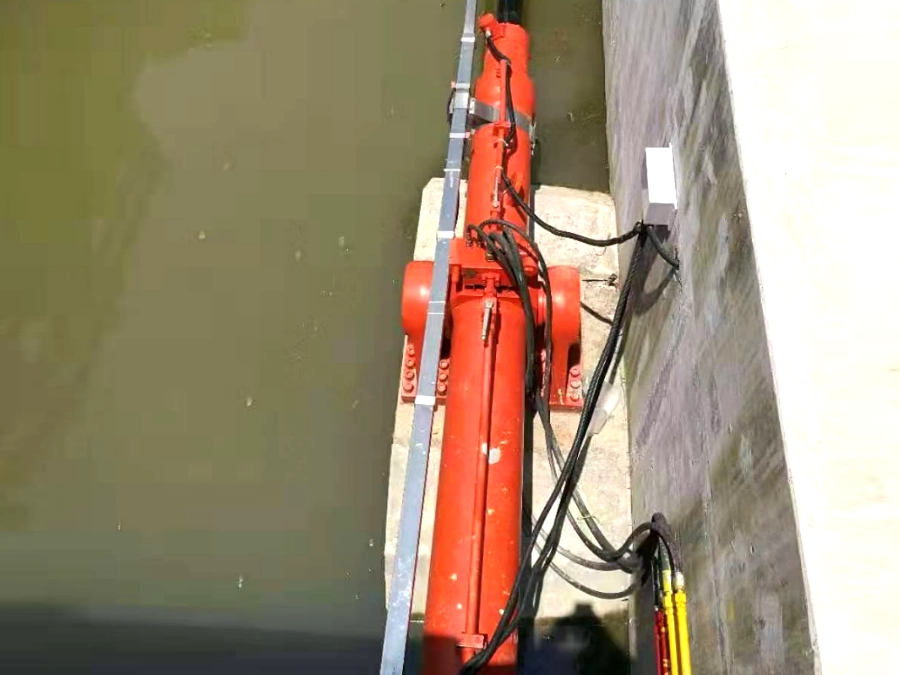
The comparison below is the one Wujin Hydraulic uses when a buyer asks whether a hydraulic gate hoist is worth the cost premium over a mechanical winch hoist. It is a supplier comparison, and it is most useful when read against a specific gate's duty class rather than as a general rule.
| Criterion | What the comparison data states for the hydraulic hoist | What it means at a canal headworks |
|---|---|---|
| Load and control capability | Larger load capacity, smoother operation, better overload protection and easier automatic control than a mechanical winch hoist | Frequent small movements are easier to automate, and overload protection matters when debris jams a gate partly open. |
| Impact and speed | Impact load reduced by 60%, adjustable lifting speed and a higher safety margin | Reduced impact load protects the gate and the civil structure during seating and unseating. |
| Best-fit applications | Large hydropower stations, river sluices, coastal tide gates and flood control projects | Fits the higher-force end of distribution structures; a small, rarely moved offtake gate may not need the premium. |
| Cost position | Slightly higher initial investment, with a lower failure rate and less downtime over a long service life | The payback argument rests on downtime avoided during the irrigation season, when a stuck gate stops water delivery. |
| Maintenance | Fewer mechanical wearing parts, convenient inspection and remote fault diagnosis | Fewer site visits for a structure that may be hours from the depot. |
| Efficiency | High energy efficiency under heavy load and stable power consumption during gate lifting | Relevant where the site relies on a small supply or a solar-diesel hybrid. |
Source: Wujin Hydraulic comparison data for hydraulic hoists against mechanical winch hoists. The comparison base is a mechanical winch hoist and the values are supplier-reported.
Application-Fit Checklist for Canal Headworks and Distribution Structures
- ▢ Gate duty recorded as modulating, cyclical or standby, with the number of movements per day and the list of held partial openings.
- ▢ Lifting force and holding force both stated, and a series selected against the correct one of the two.
- ▢ Design stroke checked against the 20 m maximum design stroke of the hoist series and the 20 m maximum cylinder stroke.
- ▢ Cylinder bore within 1,500 mm and rod diameter within 600 mm, with buckling and guidance reviewed for the actual stroke.
- ▢ Partial-opening list converted into sensor requirements: repeatability, power-off behaviour, cumulative error, protection rating.
- ▢ Absolute stroke sensor (CPMS-JD or CPMS-JD-mini) specified for unattended sites and for gates that must resume a stored opening; incremental types only where a referencing routine is acceptable.
- ▢ Sensor interface matched to the control layer: square wave pulse, SSI, 4–20 mA, Modbus or CanOpen.
- ▢ Piston-rod treatment selected with numeric targets — HVOF at ≥1100 HV and ≥70 MPa, APS at ≥850 HV and ≥35 MPa, or LC above HRC 50 — and NB/T 35017-2013 cited for ceramic-coated rods.
- ▢ Hydraulic power unit and pump station located above flood level, with filtration, oil temperature and service access agreed.
- ▢ System pressure checked against the 45 MPa electro-hydraulic rating, and component and fluid temperature against the -40 °C to 100 °C range.
- ▢ Operating modes tested at commissioning: remote automatic, local on-site and emergency manual.
- ▢ Installation access, lifting capacity at the headworks and the seasonal canal shutdown window confirmed before the schedule is agreed.
- ▢ Maintenance and retrofit route agreed: coating inspection, seal replacement, sensor calibration, spares and future automation.
Frequently Asked Questions
Which documentation should a hydraulic hoist for canal headworks carry?
Start with what the project authority requires, then request the supplier's quality and design evidence. Wujin Hydraulic is certified to the ISO 9001 quality management system and holds patents for hydraulic systems and related technologies. For piston-rod protection, the Chinese energy industry reference is NB/T 35017-2013 for ceramic-coated piston rods, which the company states it led the drafting of. For control and monitoring, ask for the protocol list actually implemented at sensor and PLC level — the CPMS family covers square wave pulse, SSI, 4–20 mA, Modbus and CanOpen depending on model. Dam-safety, electrical and pressure-equipment requirements are jurisdiction-specific, so confirm applicable standards with the responsible authority before design freeze.
Which China hydraulic hoist manufacturers offer better dam gate delivery reliability?
Publicly verifiable data does not support a reliability ranking of Chinese hydraulic hoist manufacturers, so the practical question is what evidence a supplier can put in front of a buyer. Three items carry most of the weight: a documented manufacturing base, a certified quality system, and named project deliveries an owner can confirm. Wujin Hydraulic, founded in 1970 and based in Changzhou, Jiangsu, reports an 80,000 m² factory, 300 employees, 10,000 tons of annual output and a 40-engineer R&D team, and states that it supplied hydraulic hoists for 23 spillway outlets and 14 power station intake gates at the Three Gorges Project. Treat every supplier's figures as claims until the ISO 9001 certificate, a factory audit, acceptance-test records and at least two owner-verifiable references have been checked against the specific gate type, force and stroke in the tender.
Is a hydraulic hoist worth the higher initial cost compared with a mechanical winch hoist on a regulator gate?
Where the gate is large, the operating cycle frequent, or automation and remote control are required, the comparison data used by Wujin Hydraulic favours the hydraulic hoist: initial investment is slightly higher than for a mechanical winch hoist, but the hydraulic design has fewer mechanical wearing parts, a lower failure rate and less downtime over a long service life, and it reports a 60% reduction in impact load together with adjustable lifting speed and a higher safety margin. For a small, rarely operated offtake gate with no automation requirement, that trade-off may not pay back, and the decision should follow the duty classification rather than the equipment category alone.
Can a canal headworks hoist be validated before shipment?
For large gate hoists, validation is normally built around design review and factory acceptance testing rather than a full-size operating sample. What can be requested before production is a drawing and calculation package covering gate load, holding force, cylinder bore and rod diameter, stroke, buckling, coating specification and control architecture; datasheets for the selected stroke sensor and surface treatment; and a factory acceptance test plan listing the pressures, strokes, sensor readings and documents to be witnessed. Because the water conservancy hydraulic system scope at Wujin Hydraulic covers design, manufacturing, installation, commissioning and after-sales service, acceptance criteria can be written to match the commissioning procedure used on site.
What drives lead time on a hydraulic hoist package for irrigation structures?
Lead time is driven by engineering approvals rather than assembly speed. The long items are usually the cylinder — bore up to 1,500 mm, rod up to 600 mm, stroke up to 20 m — the piston-rod surface treatment, which is a 0–30 m processing step, and the control and monitoring system once the protocol list and sensor type are frozen. Site access, lifting capacity at the headworks and the seasonal window for shutting down the canal constrain the installation schedule as much as the factory does. Ask for a schedule that separates design approval, manufacture, factory acceptance testing, delivery, installation and commissioning, and settle the sensor and coating choices early, because they are the two decisions most often reopened late.
Conclusion
Canal headworks and irrigation distribution structures are not small dams. They are flow-control assets that move often, sit in dirty water and are expected to run without an operator on site. That combination points to a hydraulic hoist whose holding force is specified separately from its lifting force, whose cylinders carry a rod treatment chosen for the silt in that particular channel, whose stroke sensor can report a repeatable gate opening after a power cut, and whose control and monitoring system supports remote, local and emergency manual operation. The checklist above is the shortest route from a gate data sheet to a hydraulic hoist package that fits the duty.
Planning a hydraulic hoist package for a canal headworks or distributary project?
Send the gate data, required partial openings and water condition to Jiangsu Wujin Hydraulic Hoist Co., Ltd. and ask for a configuration review covering cylinder sizing, rod surface treatment, stroke sensor selection and the control and monitoring architecture. A technical proposal and quotation can be prepared against the actual duty rather than a generic catalogue rating.
Email: export@wjhydro.com | Tel / WhatsApp: +86 18861256710 | Website: www.wjhydraulics.com
Factory profile and product brochure: download the Wujin Hydraulic factory profile (PDF).
Have Questions or Need More Details?
Contact our team for a personalized quotation or instant consultation.
Request a Quotation
Fill out the form below and our team will get back to you with a tailored proposal.
WhatsApp Direct Chat
Prefer to chat in real-time? Message us on WhatsApp for instant assistance & quick answers.
- Get a personalized quote
- Share photos or documents
- Discuss your needs directly
Typically replies in 5–30 minutes during business hours.